
 By
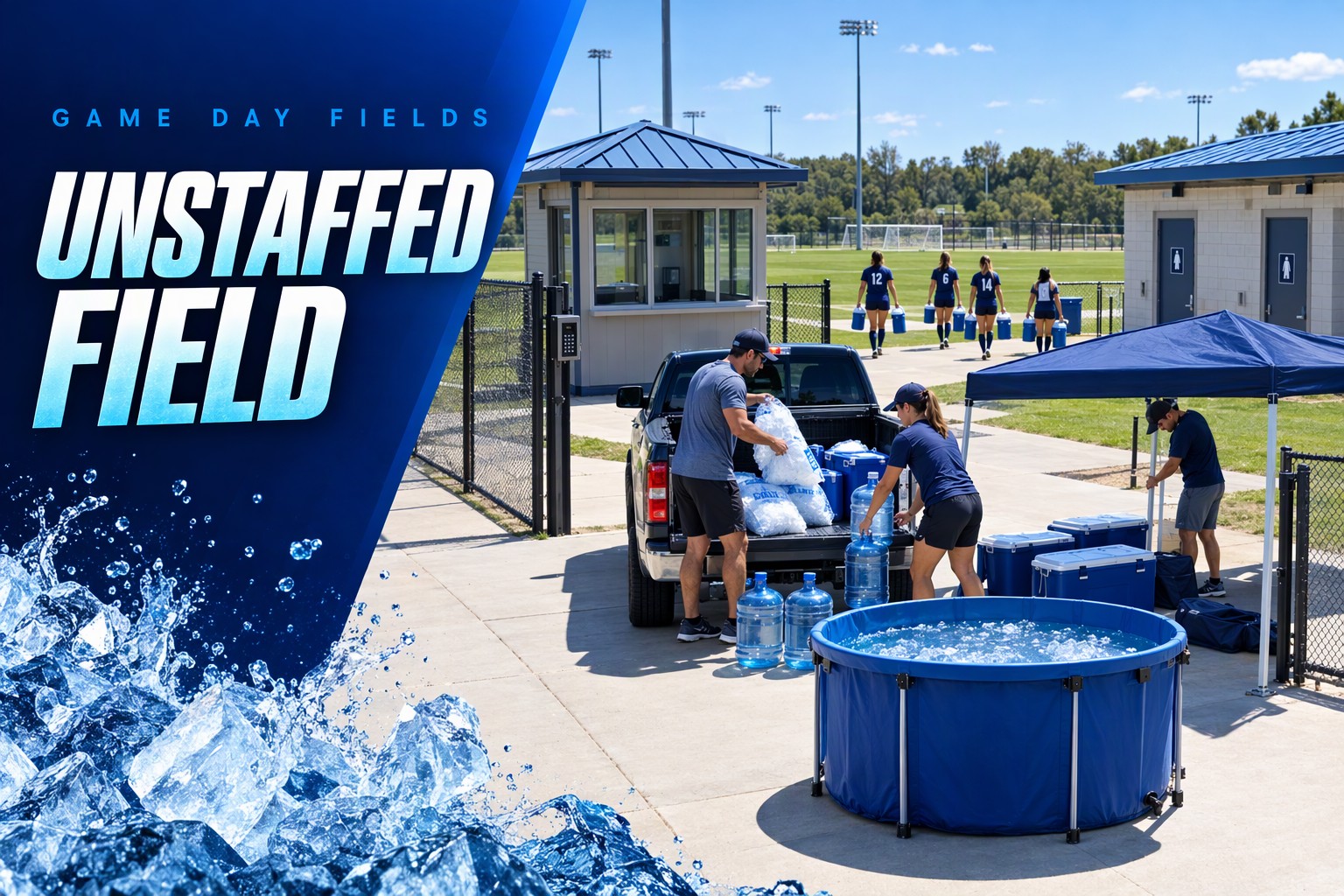
A lot of field rentals run on their own. You book online, get a gate code or a key, and show up to an empty complex. Nobody from the field is there. No one to unlock the restroom, turn on the water or point an ambulance to the right gate. That can be fine on a mild day. On a hot one, it means your team is the whole plan. Here is how to get ready when you will be the only people at the field.
Ask the right questions when you book
Before you pay, find out what will and will not be open when you get there. Ask the owner or manager:
- Will anyone from the field be on site during your time? If not, who answers the phone if something goes wrong?
- Is there drinking water, and will it be turned on? Our guide to planning drinking water at a rented field covers what to ask.
- Will the restrooms be unlocked, and is there any indoor or shaded space you can use?
- Which gates will be locked, and how does an ambulance get in?
- Can you bring a cooling tub, a tent and ice, and where can you set them up?
Write the answers down. If the owner cannot answer one, plan as if the answer is no.
Plan as if nothing on site will be there
When no one from the field is around, bring what you would need if the water, the shade and the restrooms were all closed. That means your own drinking water, your own shade and your own cooling setup. Our heat kit for a rented field lists what to pack, and our guide to bringing a cooling tub to a rented field covers the tub itself.
Bring more ice than you think you need. There is no snack bar or ice machine to fall back on. Our ice plan for a rented field walks through getting, storing and restocking it.
Get there early and open up
Have one adult arrive before the players. Use that time to:
- Unlock the gate you will use and check that the code or key works.
- Set up the tent, the water and the filled cooling tub before warm-ups start.
- Check cell signal on the sideline, and find where it is better if it is weak.
- Look at which gate is closest to your field and whether an ambulance can drive through it.
Our quick heat walk-through when you arrive has a full list.
Make the ambulance plan yours
With no staff on site, nobody else will meet the ambulance. Know the exact address, the gate number or name and the field number before anyone calls. Pick one adult to go to the gate and wave the crew in, and a backup in case that person is helping cool the player. If a gate has to be opened, that adult should have the code or key in hand. Our guide to giving 911 directions to a rented field shows how to write it out.
Save the owner’s phone number too, so you can tell them what happened, but do not wait on them to call 911 or open a gate.
Give every adult a job
Without field staff, the adults on your team fill every role. Before practice or the game starts, decide who calls 911, who runs the cooling, who meets the ambulance and who stays with the rest of the players. Our guide to game-day heat roles lays out each job. If you only have one or two adults, keep the group smaller or move the time to a cooler part of the day.
Put all of it on one sheet and keep it in the team bag. Our guide to putting your heat plan on one page shows what to include.
Leave it the way you found it
Before you go, count your players, make sure every one has a ride and stays in the shade until it arrives, and lock any gate you opened. If something happened during your time, let the owner know that day so the next team is not caught off guard.
Warning signs to watch for
A player who is dizzy, sick to their stomach, has a headache or looks wiped out should stop, drink water and rest in the shade with an adult beside them. Call 911 right away if a player is confused, slurring words, passes out or stops acting like themselves.
If a player goes down
If a player collapses in the heat, the adults on your team are the first responders until the ambulance arrives:
- Call 911 and start cooling at the same time.
- Cooling should start within 10 minutes, using cold-water immersion with ice agitation.
- Cool first, then transport. The goal is about 102°F within 30 minutes.
Take off whatever gear comes off quickly, but never delay cooling to remove gear.
Around 104°F, the body loses its ability to regulate its own temperature. Exertional heat stroke is 100% survivable when it is recognized fast and the athlete is cooled on the spot.
While one adult cools the player, another stays with the rest of the team in the shade, and the person named in the plan goes to the gate to meet the ambulance.
Free help from National Stay Cool Day
Use the National Stay Cool Day cooling station checklist to set up your own cool zone, and make sure every adult with the team knows the warning signs of exertional heat stroke.
Take the next step: build your heat emergency action plan with our free heat safety tools, then sign up your school for National Stay Cool Day on April 8, 2027. Both are free.