
 By Gamedayfields
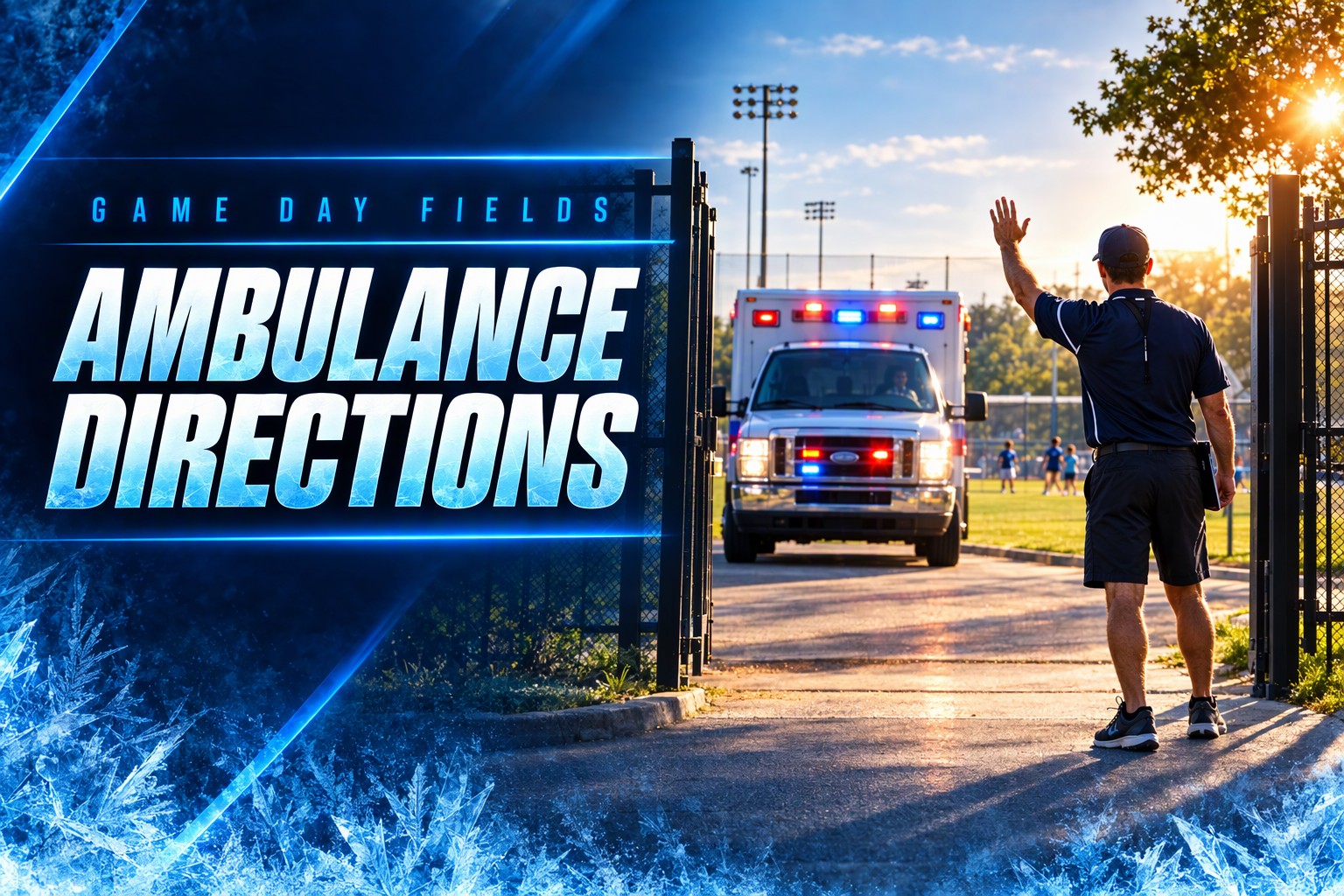
When an athlete goes down on a rented field, someone calls 911 right away. Then the dispatcher asks, “Where are you?” On a field you have only played on twice, at a park with three entrances and six diamonds, that question can eat up minutes you do not have. Work out the answer before game day, write it down, and make sure the ambulance can get to your field, not just to the parking lot.
What 911 needs to hear
A street address gets an ambulance to the property. It does not always get the crew to your athlete. Have all of this on one card:
- The street address of the field or complex, not the address on the rental email if that is the owner’s office.
- The name of the park or complex and the field number or name, such as “Field 4, the back diamond.”
- Which entrance or gate to use, and which road it is on.
- Any gate code, padlock or locked service road, and who has the key.
- A landmark the crew can see from the road: a water tower, a concession stand, a scoreboard.
- Your call-back number, in case the call drops.
Read the card out loud as written. Stay on the line and answer the dispatcher’s questions while others start cooling.
Ask the field owner before you book
The person who rents you the field knows things you won’t find on a map. Ask:
- What address do ambulances use to reach this field?
- Can an ambulance drive close to the field, or will the crew have to walk in?
- Are any gates locked during our booking? Who opens them, and how fast?
- Has an ambulance come here before, and did it have trouble finding the field?
- Is there an AED on site, and where is it kept?
If the answers are vague, plan for the slowest case and add a runner.
Send a runner to the gate
Name one adult before warm-ups whose only job in an emergency is to meet the ambulance. That person walks or drives to the entrance as soon as 911 is called, waves the crew in and leads them straight to the athlete. Pick a backup, too. The runner should not be the person cooling the athlete or the person on the phone.
If you can, have the runner open any gate and move cones, cars or equipment out of the way before the ambulance arrives.
Cool first while help is on the way
Exertional heat stroke is 100% survivable when it is recognized fast and the athlete is cooled on the spot. Good directions keep the crew from getting lost. They do not replace cooling.
- Call 911 and start cooling at the same time.
- Cooling should start within 10 minutes, using cold-water immersion with ice agitation.
- Cool first, then transport. The goal is about 102°F within 30 minutes.
- When the crew arrives, the runner brings them to the tub and the adult in charge tells them when cooling started.
Take off whatever gear comes off quickly, but never delay cooling to remove gear.
Around 104°F, the body loses its ability to regulate its own temperature. Every minute spent lost in a parking lot is a minute that matters.
Make the card part of the kit
Write the directions card once per field and keep it in your game-day heat kit, next to the roster and emergency contacts. Give a copy to every coach and to the runner. If you play at a new field, make a new card before the first game.
The free National Stay Cool Day EAP Builder has a place for your field address, entrance and roles, so the card and your emergency action plan match. To learn the warning signs, read exertional heat stroke symptoms every coach and parent should know.

[…] the Final Whistle: A Heat Plan for Pack-Up on a Rented Field Can the Ambulance Find You? Giving 911 Directions to a Rented Field The Heat Kit: What to Bring to a Rented Field on a Hot Game Day Count Every Player: A […]
[…] at a Rented Field After the Final Whistle: A Heat Plan for Pack-Up on a Rented Field Can the Ambulance Find You? Giving 911 Directions to a Rented Field The Heat Kit: What to Bring to a Rented Field on a Hot Game Day Count Every Player: A […]
[…] at a Rented Field After the Final Whistle: A Heat Plan for Pack-Up on a Rented Field Can the Ambulance Find You? Giving 911 Directions to a Rented Field The Heat Kit: What to Bring to a Rented Field on a Hot Game Day Count Every Player: A […]
[…] at a Rented Field After the Final Whistle: A Heat Plan for Pack-Up on a Rented Field Can the Ambulance Find You? Giving 911 Directions to a Rented Field The Heat Kit: What to Bring to a Rented Field on a Hot Game Day Count Every Player: A […]
[…] at a Rented Field After the Final Whistle: A Heat Plan for Pack-Up on a Rented Field Can the Ambulance Find You? Giving 911 Directions to a Rented Field The Heat Kit: What to Bring to a Rented Field on a Hot Game Day Count Every Player: A […]
[…] at a Rented Field After the Final Whistle: A Heat Plan for Pack-Up on a Rented Field Can the Ambulance Find You? Giving 911 Directions to a Rented Field 20 Nov 2026, […]
[…] guide to giving an ambulance directions to a rented field shows how to write the address and gate so a crew can find […]
[…] guide to giving 911 directions to a rented field shows how to write out the address and route so a dispatcher can use […]
[…] fields can be hard to find, with a back gate, a shared lot or no clear street address. Our post on giving 911 directions to a rented field walks through what to have ready, and our guide to game-day heat roles lays out the other jobs, […]