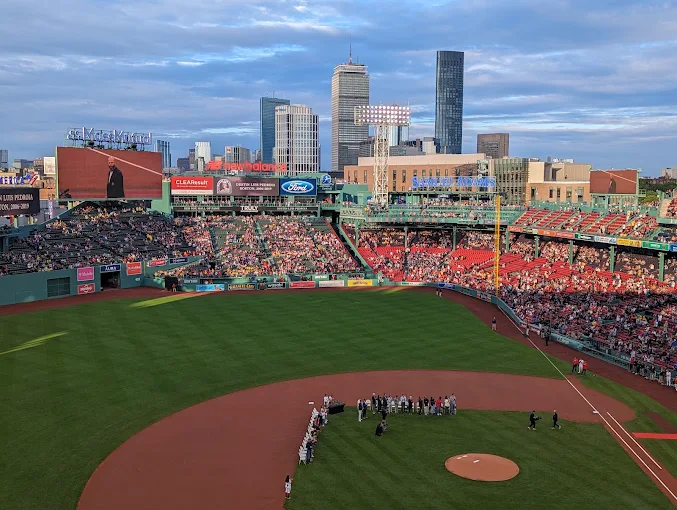
While players come and go, the fields they play on can live for generations. Across the United States, several sports fields have transitioned from simple patches of dirt and grass into living, breathing museums. These hallowed grounds tell the story of American sports culture through their unique quirks, structural evolutions, and the literal soil beneath them.
1. Fenway Park (Boston, Massachusetts)
Opened in 1912, Fenway Park is the oldest active ballpark in Major League Baseball. Its most defining characteristic is the Green Monster, a 37-foot-foot-2-inch left-field wall that sits just 310 feet from home plate.
Did You Know? The Green Monster wasn’t always green. It was originally covered in advertisements until 1947, when it was painted its signature “Fenway Green” to match the rest of the ballpark.
Fenway’s field layout is notoriously asymmetrical, causing unique challenges for outfielders who must navigate the unpredictable angles of the historic brick and mortar walls.
2. Wrigley Field (Chicago, Illinois)
Just two years younger than Fenway, Wrigley Field (1914) is famous for its iconic ivy-covered brick outfield walls. The Boston Ivy was planted in 1937 by legendary executive Bill Veeck to beautify the park.
- The Ground Rule: If a batted ball gets permanently lost in the thick green ivy, it is ruled a ground-rule double.
- The Wind Factor: Because of its proximity to Lake Michigan, the wind directions at Wrigley can completely change field playability from inning to inning, turning routine fly balls into home runs or vice versa.
3. Lambeau Field (Green Bay, Wisconsin)
Shifting to gridirons, Lambeau Field has hosted the Green Bay Packers since 1957. Known as “The Frozen Tundra,” Lambeau revolutionized cold-weather field maintenance in 1967 by installing an underground heating system—consisting of miles of cables—to prevent the ground from freezing solid during the historic “Ice Bowl.”
Today, the field uses a highly sophisticated sub-air heating and ventilation system that keeps the soil temperature at an optimal 55°F, ensuring the grass stays green and alive even when surrounded by snowbanks.
4. Harvard Stadium (Boston, Massachusetts)
Built in 1903, Harvard Stadium is America’s oldest permanent concrete structure dedicated to college athletics. The field itself changed the rules of football forever. When the game was deemed too dangerous in the early 1900s, organizers wanted to widen the field to reduce collisions. However, because Harvard’s concrete stadium walls were already set in stone, the field couldn’t be widened. Instead, the committee legalized the forward pass in 1906 to open up the game within the existing field dimensions.
These historic fields remind us that sports architecture isn’t just about housing a game; it actively shapes the rules, strategies, and memories of the sports we love.
Leave a Reply