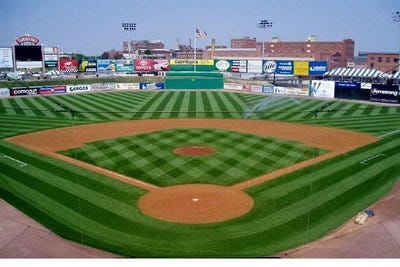
While standard rules dictate the dimensions of football fields and baseball diamonds, some facilities across the United States have thrown the traditional blueprint out the window. Whether born from branding genius, geographical constraints, or structural necessity, these unique fields have carved out their own legendary status.
1. Albertsons Stadium (Boise State University – Idaho)
You cannot talk about unique sports fields without mentioning the home of the Boise State Broncos. Installed in 1986, “The Blue” was the first non-green synthetic turf field in Division I college football history.
Originally conceived by athletic director Gene Bleymaier as a way to get the small university national attention on a budget, the iconic blue turf became an instant cultural phenomenon. It gave birth to the “Blue Turf Rule” in the NCAA, which eventually required subsequent schools with non-traditional field colors to register and receive official approval.
2. Isotopes Park (Albuquerque, New Mexico)
Minor League Baseball is famous for its quirky promotions, but the Albuquerque Isotopes took it straight to the field architecture. In right-center field sits a feature known simply as “The Hill.” Modeled after old-school ballparks like Crosley Field, it features a literal 5-foot earthen incline built right into the field of play, complete with a warning track running up it. Outfielders have to sprint uphill while tracking fly balls, creating some of the most chaotic and entertaining defensive highlights in baseball.
3. War Memorial Stadium (Maui, Hawaii)
Imagine playing football while fighting tropical trade winds and looking out over the Pacific Ocean. War Memorial Stadium features a field layout aligned perfectly with the local valley wind tunnels.
Field managers and coaches must adapt to severe crosswinds that routinely alter the trajectory of field goals and punts. The field’s unique volcanic soil base also requires specialized local Bermuda grass strains that can thrive in highly porous, high-salinity coastal environments.
4. Polar Park (Worcester, Massachusetts)
Opened recently to host minor league baseball, Polar Park embraces its urban environment rather than fighting it. The field is built over a steep grade change in the city, resulting in a right-field wall that sits below the street level of the city outside.
Fans sitting in the right-field stands look down onto the field, while pedestrians on the sidewalk can look right through the gaps in the stadium walls to check the score, blending public city life seamlessly with the field itself.
These stadiums prove that field design doesn’t have to be uniform. Embracing local flair and unconventional design can turn an ordinary game-day field into an unforgettable destination.
Leave a Reply