
 By Gamedayfields
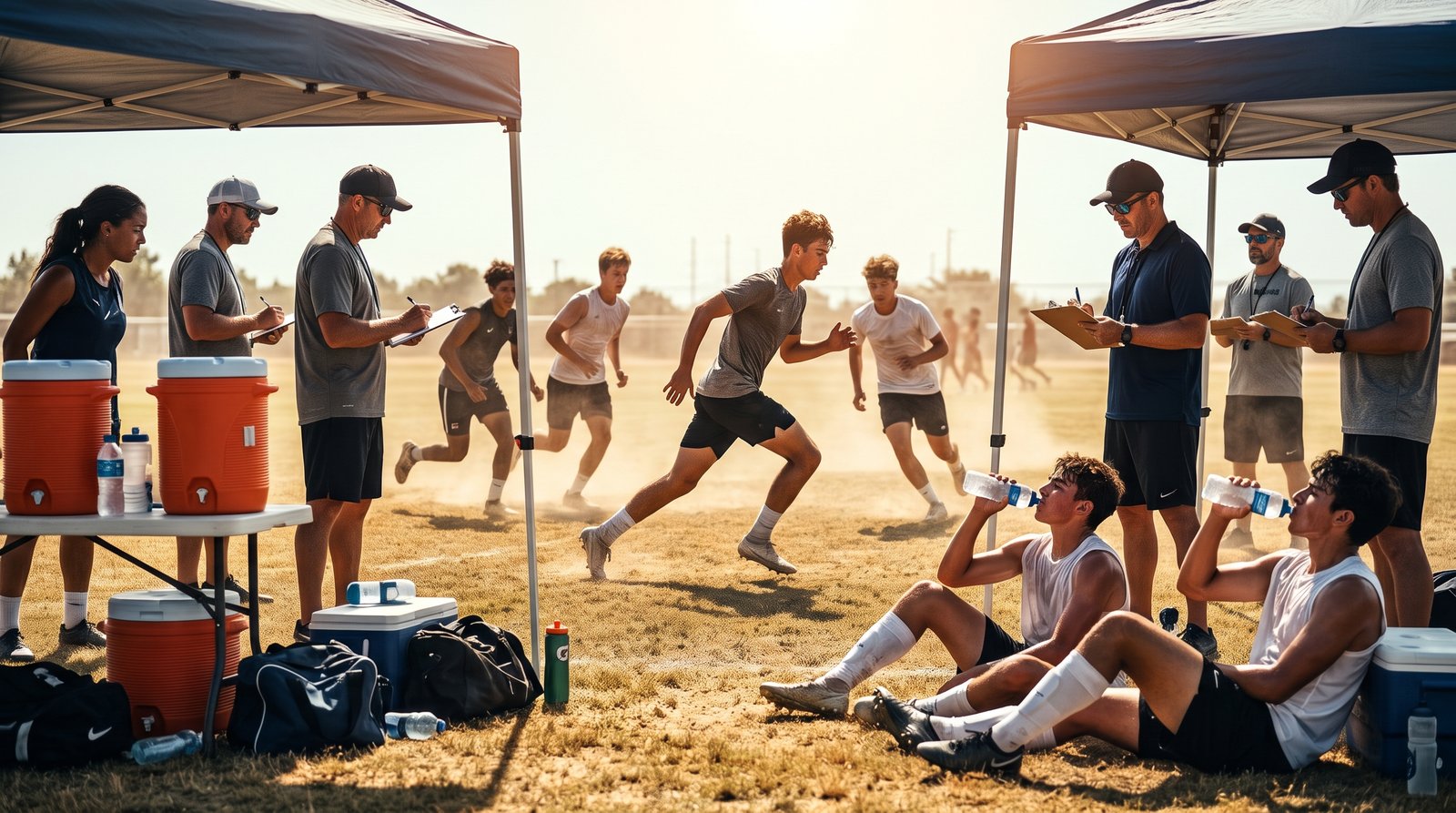
A showcase or skills clinic on a rented field pulls in players from a dozen different teams. Most of them came without their own coach. The people running the day are watching drills, timing sprints and taking notes. Every player is trying to stand out, and none of them wants to be the one who sits down. That mix makes the heat plan easy to forget and very important to have.
Why a showcase is different from a team practice
At a normal practice, a coach knows the players and can tell when one of them looks off. At a showcase, the staff may have never seen these kids before. Parents are often in the stands or in the parking lot. Players push through drills because someone with a clipboard is watching. Stations are spread across the field, so a player in trouble at the far end can go unnoticed.
Settle it when you book the field
Before the day, the organizer should know:
- Where the cooling tub will go, who is bringing it, and who is bringing the ice and water.
- The field address, field number and the gate an ambulance would use.
- One person whose only job that day is safety, not running a station.
- Who calls 911 and who meets the ambulance at the gate.
- Whether an earlier or later time slot is open on hot days. It is worth asking the field owner.
Collect a parent or guardian phone number for every player at check-in, and keep the list with the safety lead, not in a car.
Before the first drill
- Fill the tub with water and ice before players warm up.
- Walk every station leader to the tub so they know where it is.
- Tell players, out loud, that stepping out for water or shade will not count against them. Then mean it.
- Put water and shade near each station, not only at the check-in table.
During the day
Build water breaks into the schedule for every group at the same time, so no player feels they are missing a rep. Station leaders should watch for stumbling, confusion, acting strange, collapsing, or a sudden drop in effort. Do not wait for a player to complain. A player trying to impress the staff is the least likely to speak up.
If a player looks off, take them out of the drill and keep an adult with them. Do not send them to sit alone in a car or walk off to find a parent.
If a player goes down
Exertional heat stroke is 100% survivable when it is recognized fast and the athlete is cooled on the spot.
- Call 911 and start cooling at the same time.
- Start cooling within 10 minutes, using cold-water immersion with ice agitation.
- Cool first, then transport. The goal is about 102°F within 30 minutes.
- The person assigned to the gate meets the ambulance and walks the crew to the player.
- Call the player’s parent or guardian from the check-in list, but do not stop cooling to do it.
Take off whatever gear comes off quickly, but never delay cooling to remove gear. Around 104°F, the body loses its ability to regulate its own temperature. Cooling on the spot is what brings it back.
Put it on one page
The free EAP Builder from National Stay Cool Day turns the field address, gate, phone numbers and cooling steps into a one-page emergency plan. Print one for the safety lead and one for each station, and keep a copy with the check-in list.
Take the next step: build your heat emergency action plan with our free heat safety tools, then sign up your school for National Stay Cool Day on April 8, 2027. Both are free.
