
 By Gamedayfields
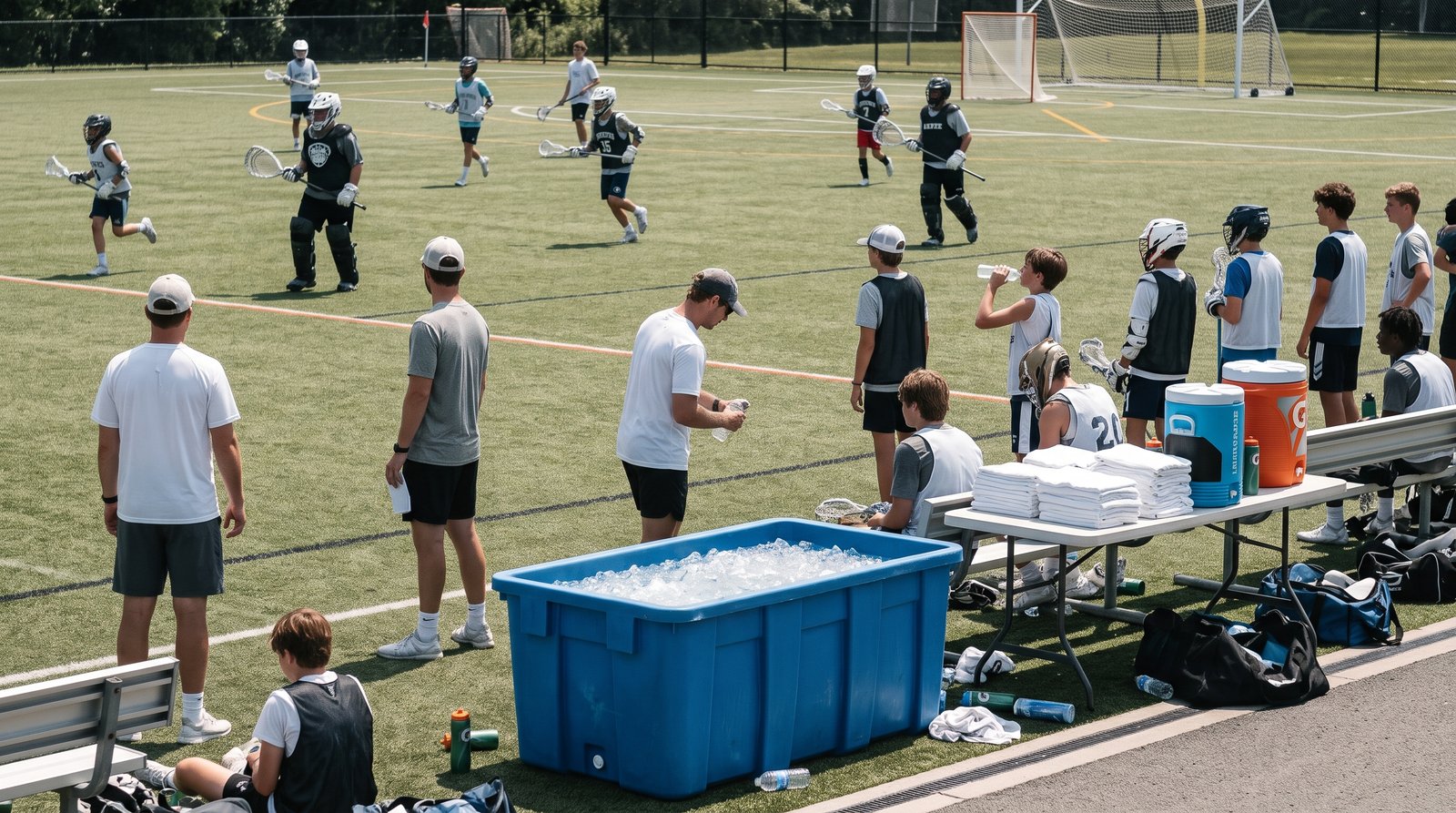
Turf fields are easy to book, drain fast after rain and look great under lights. On a hot, sunny afternoon they’re also one of the hottest places a team can play. If you’re renting a turf field for a summer practice or game, plan for the surface as well as the air temperature.
Why turf runs hotter
Grass holds moisture and gives some of the sun’s heat back to the air as that water evaporates. Synthetic fibers and rubber infill don’t. Researchers at Penn State’s Center for Sports Surface Research have measured synthetic turf running far hotter than natural grass on sunny days. Players feel that heat through their cleats, and the air right above the surface warms up too.
Watering the field helps, but not for long. The same Penn State work found that a wet turf surface cools down right away and then heats back up within minutes, well before a game would end.
Before you book
- Ask the field owner whether there’s a grass field you could use instead on a hot day, or a cooler time slot.
- Look at the time of day. Early morning and evening slots keep players off the surface during the strongest sun.
- Ask where the shade is. Many turf complexes have open sidelines with nothing overhead.
- Ask where water is available on site and whether you can bring a tub and ice.
- Get the field’s street address and field number for your emergency plan.
On game day
- Check conditions at the field itself, not just the forecast for your town. A turf field in full sun can feel very different from the parking lot.
- Set up shade and the cooling station before warmups, close to the field.
- Take breaks off the surface, in the shade, not standing on the turf.
- Sub players more often and keep breaks real, not just a quick sip.
- Remind players not to sit or lie on the turf between drills.
Know the warning signs
Athletes in trouble usually won’t say so. Watch for a player who seems confused or not like themselves, stumbles, falls behind or goes down during play. Pull them off right away and get help. Don’t wait for the next break.
If an athlete goes down
Exertional heat stroke is 100% survivable when it’s recognized fast and the athlete is cooled on the spot.
- Call 911 and start cooling at the same time.
- Start cooling within 10 minutes, using cold-water immersion with ice agitation.
- The goal is to bring the body to about 102°F within 30 minutes.
- Cool first, transport second.
Take off whatever gear comes off quickly, but never delay cooling to remove gear. Around 104°F, the body loses its ability to regulate its own temperature. Cooling on the spot is what brings it back.
Write the plan down
Before your first hot day on turf, put the field address, who calls 911 and where the cooling setup goes on paper. The free EAP Builder from National Stay Cool Day walks you through it and gives you a printable plan to share with coaches and families.
Want to know more about how turf and grass compare beyond heat? Read The Modern Turf War: Real Grass vs. Synthetic Turf.
Take the next step: build your heat emergency action plan with our free heat safety tools, then sign up your school for National Stay Cool Day on April 8, 2027. Both are free.
