
 By Gamedayfields
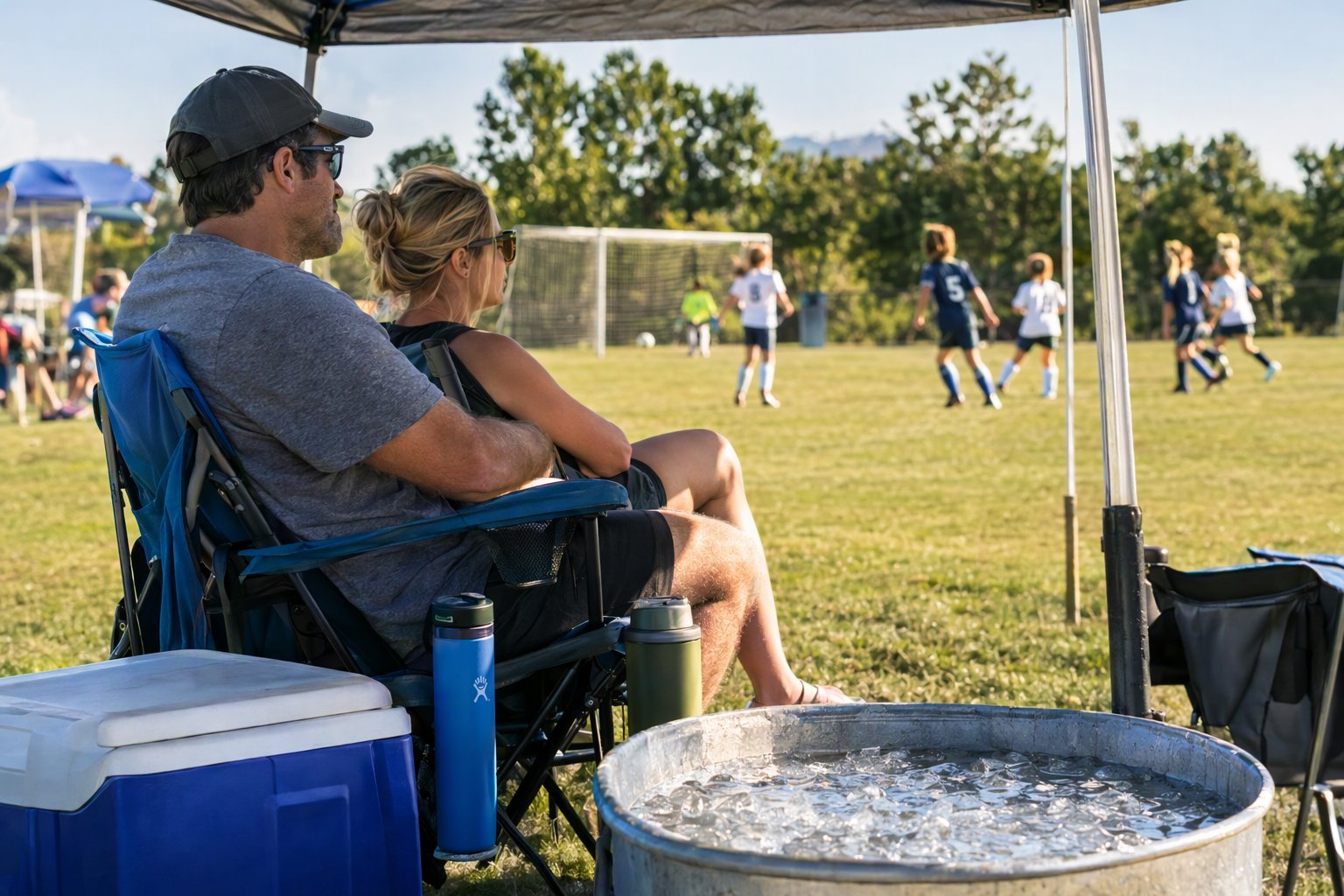
When your kid’s team plays on a rented field, there may be no athletic trainer, no medical tent and no one assigned to watch for heat trouble. The adults on the sideline are often the closest help there is. Here’s how to be useful.
Before you leave the house
- Ask the coach or organizer one question: where is the cooling setup and who calls 911? If nobody knows, that’s worth a conversation before the game, not during it.
- Save the field’s street address and field number in your phone. A 911 call goes faster when you can say exactly where you are.
- Pack more water than you think your kid needs, plus some for yourself.
- Bring shade if you can: a pop-up canopy, an umbrella or a spot under a tree you find early.
Offer to bring the cooling setup
A tub or a large cooler, water and plenty of ice, set up close to the field before warmups start. Coaches running a youth team on a borrowed field are juggling a lot. A parent who says “I’ve got the tub and the ice this week” fills a real gap. Some teams rotate it like snack duty.
What to watch for during the game
Kids rarely say they’re in trouble. They want to stay in. Watch for a player who:
- seems confused, dazed or not like themselves
- stumbles, can’t keep up or stops making sense
- collapses or goes down during play
If you see it, tell the coach right away. Don’t wait until halftime and don’t assume someone else noticed.
Help the team take real breaks
- Get water and shade ready so breaks are quick and actually cool players down.
- Back the coach up when they sub players out more often in the heat.
- Don’t treat a short rest or a cold drink as proof a struggling kid is fine.
Take care of the sideline too
Little brothers and sisters, grandparents and parents sit in the same sun for hours. Keep younger kids in the shade, keep everyone drinking, and don’t wait out a long tournament day in a hot car.
If a player goes down
Exertional heat stroke is 100% survivable when it’s recognized fast and the athlete is cooled on the spot. If you think a player has it:
- Call 911 and start cooling at the same time.
- Start cooling within 10 minutes, using cold-water immersion with ice agitation.
- The goal is to bring the body to about 102°F within 30 minutes.
- Cool first, transport second.
Take off whatever gear comes off quickly, but never delay cooling to remove gear. Around 104°F, the body loses its ability to regulate its own temperature. Cooling on the spot is what brings it back.
Help the team write it down
If your team doesn’t have an emergency action plan for the field, offer to put one together. The free EAP Builder from National Stay Cool Day walks you through the field address, who calls 911 and where the cooling setup goes, and gives you a printable plan to share with every family.
Take the next step: build your heat emergency action plan with our free heat safety tools, then sign up your school for National Stay Cool Day on April 8, 2027. Both are free.

[…] parents not to leave a player at the field until they see an adult from the team. Our guide for parents on the sideline covers what families should bring on a hot day, and our heat plan for pack-up covers players […]
[…] practice starts. Our one-page heat plan for a rented field is an easy thing to forward, and our guide for parents on the sideline covers what families should […]