
 By Gamedayfields
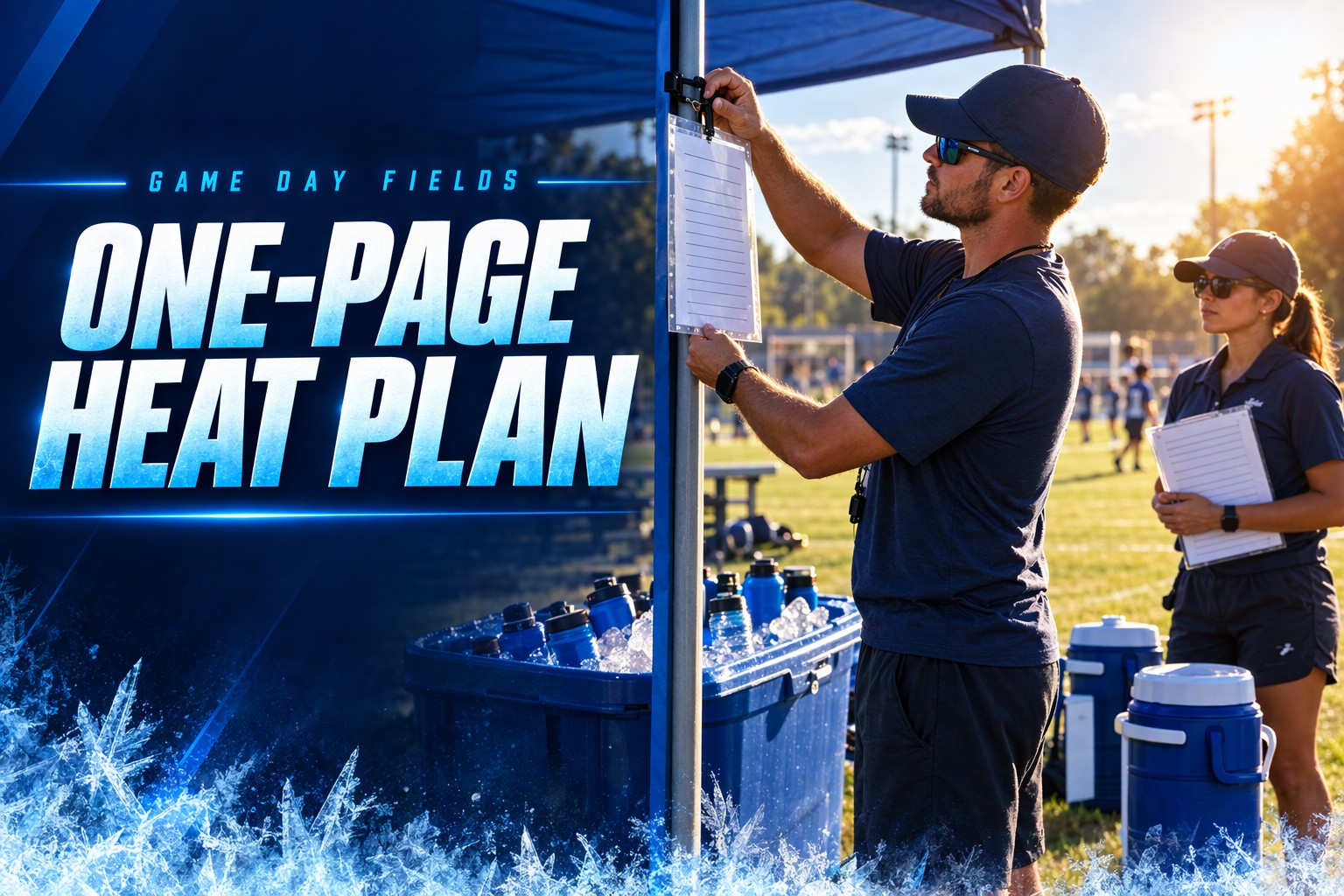
Most teams that rent a field have some kind of heat plan, but it often lives in one coach’s head or in a long group text. When a player goes down on a hot day, nobody has time to scroll back through messages. A written plan on one page, with copies at the bench, in the team bag and in the field owner’s hands, means every adult at the field knows what to do. Here is what to put on it and where it should go.
Why one page
A long plan does not get read. One page does. If a parent who has never helped before can pick it up and follow it right away, it is short enough. Use plain words and big type.
What goes on the page
Write the plan for this field, not for fields in general. If you rent more than one field, make a page for each one.
- The field name and street address, plus the gate or entrance an ambulance should use.
- Where the cooling tub, ice, drinking water and shade will be set up.
- Who calls 911, who starts cooling and who meets the ambulance at the gate, with a backup for each.
- Phone numbers for the head coach and the field owner or manager.
- The warning signs to watch for, in a few words each.
- The emergency steps, word for word, from the section below.
- The date you last updated it.
Our guide to giving an ambulance directions to a rented field shows how to write the address and gate so a crew can find you.
Fill it in with the field owner
Some answers only the owner or manager has. Before the season or event, ask them:
- Which gate will be open during your time, and who has the key?
- Where can you set up a cooling tub and a shade tent?
- Is there drinking water at the field, and will it be on?
- What is the best number to reach someone on game day?
Then give them a finished copy. Our heat questions field renters ask covers more of what to ask, and owners can use our heat emergency briefing for field staff to get their own people ready.
Post it where people will see it
- One copy clipped at the bench or under the shade tent, at eye level.
- One copy in the team bag, so it travels with the gear and not with one person.
- One copy for the field owner or manager.
- A photo of it on the phone of every coach and team parent.
Put the posted copy in a plastic sleeve so sweat, rain and sprinklers do not ruin it. Pack the team bag copy with the rest of your game-day heat kit.
Walk through it before the first hot day
A plan on paper only helps if people know it. At the first practice, walk every coach and helper through the page, show them where the tub and water will be, and point to the gate the ambulance will use. Then run a short drill: one person calls out “player down,” and everyone does their part. Repeat it whenever new adults join.
Keep it current
Update the page and swap the posted copy whenever the field, time slot, gate, coaches or phone numbers change. Teams renting the same field all season can use our season-long field rental heat plan to keep it up to date week to week.
Warning signs to put on the page
A player who is dizzy, sick to their stomach, has a headache or looks wiped out should stop, drink water and rest in the shade with an adult beside them. Call 911 right away if a player is confused, slurring words, passes out or stops acting like themselves.
If a player goes down
Put these steps on the page exactly as written, in the biggest type on the sheet. If a player collapses in the heat, stop everything and turn to the player:
- Call 911 and start cooling at the same time.
- Cooling should start within 10 minutes, using cold-water immersion with ice agitation.
- Cool first, then transport. The goal is about 102°F within 30 minutes.
Take off whatever gear comes off quickly, but never delay cooling to remove gear.
Around 104°F, the body loses its ability to regulate its own temperature. Exertional heat stroke is 100% survivable when it is recognized fast and the athlete is cooled on the spot.
The adult named on the page goes to the gate to meet the ambulance and walk the crew to the field.
You do not have to start from a blank page
The free heat emergency action plan builder from National Stay Cool Day walks you through each part of a plan and lets you download it to print. It is written for schools, but the same parts fit a rented field. Use the National Stay Cool Day cooling station checklist to set up the spot your page points to, and make sure every adult at the field knows the warning signs of exertional heat stroke.
Take the next step: build your heat emergency action plan with our free heat safety tools, then sign up your school for National Stay Cool Day on April 8, 2027. Both are free.

[…] a copy of the permit with your plan in the team bag. Our guide to putting your heat plan on one page shows what to […]
[…] have seen the field, know where the team sets up and have a copy of the heat plan. Our guide to putting your heat plan on one page shows what that copy should […]
[…] a hot day, and add the player’s emergency contacts to your list before practice starts. Our one-page heat plan for a rented field is an easy thing to forward, and our guide for parents on the sideline covers what families should […]