
 By Gamedayfields
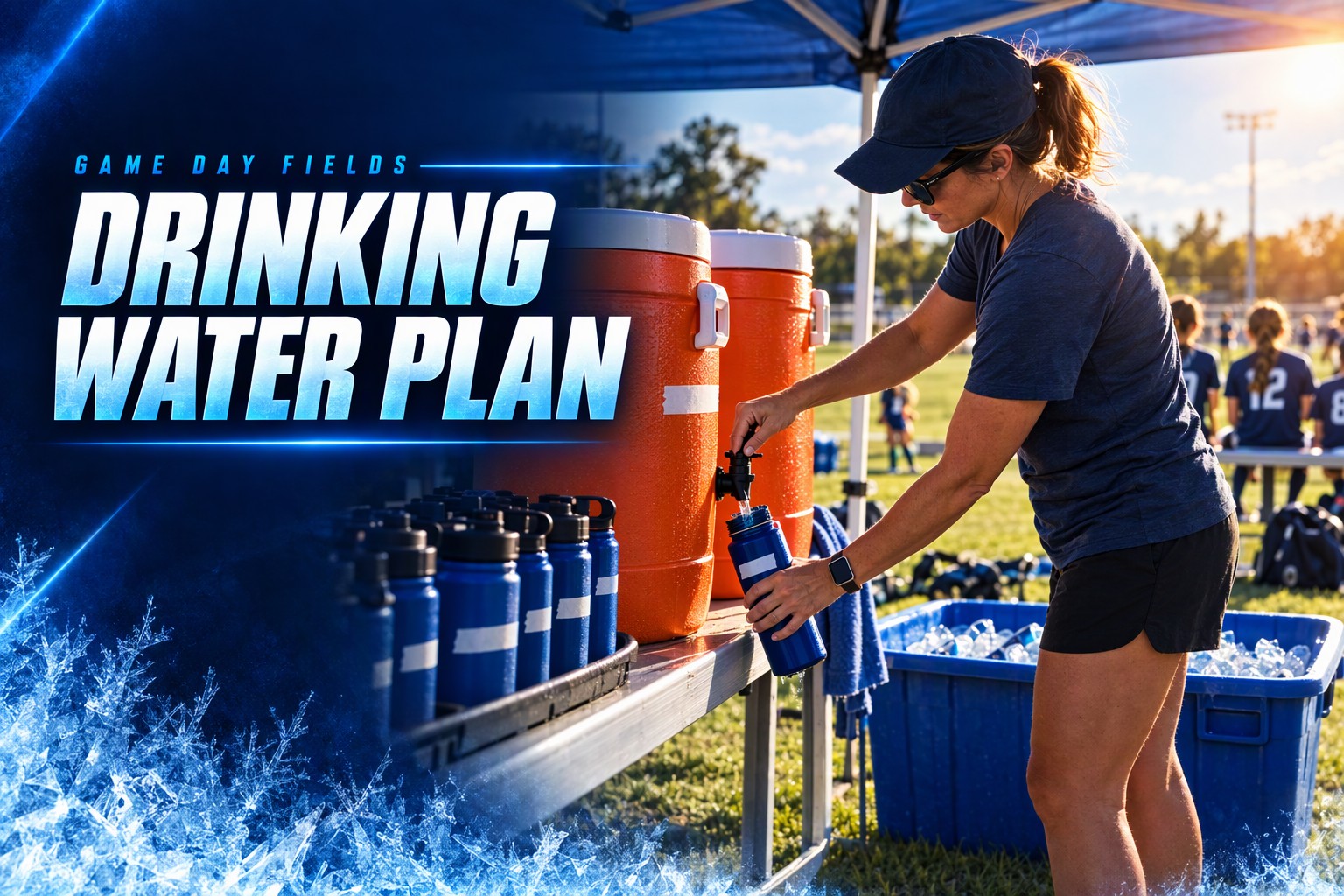
Plenty of rented fields have no water fountain, no spigot near the bench, or a spigot that turns out to be locked or broken when you get there. On a hot day that is a real problem, because drinking water is one of the things a team cannot run out of. Here is how to plan your water before you book, bring enough of it, and keep it flowing until the last player leaves.
Ask about water before you book
Do not assume the field has water. Ask the owner or manager a few simple questions when you book:
- Is there drinking water at the field, and how close is it to the bench?
- Is there a spigot or hose you can use to fill jugs, and will it be on and unlocked during your time?
- Is there anywhere to get ice or more water nearby if you run low?
- Can you bring your own water jugs, coolers and a cooling tub onto the field?
Write the answers down and share them with every coach and team parent. If the answer is “no water at the field,” plan as if you are bringing every drop yourself. Our heat questions field renters ask covers more of what to ask the owner.
Bring more than you think you need
Teams almost never run out of water because they brought too much. Plan for a hotter day than the forecast, a longer session than the schedule, and a few extra people on the sideline. Siblings, parents and coaches get thirsty too.
- Ask every player to bring a full water bottle with their name on it.
- Bring large team jugs on top of that, filled before you leave home.
- Keep a few spare bottles or cups for the player who forgets theirs.
- Keep the cooling tub and its ice separate from the drinking water. The tub is for an emergency, not for refilling bottles.
Water and ice go together. Our guide to getting and storing ice for the whole day shows how to keep both from running out.
Keep the water in the shade
Jugs and bottles left in the sun get warm fast, and players drink less when the water is warm. Set the water up under the shade tent next to the bench, with the cooling tub nearby. If the field has no shade, bring your own, and set up a cool zone like the one in our open-field shade plan.
Name a water parent
When everyone is in charge of the water, no one is. Ask one adult to own it for the day. That person watches the jugs, refills bottles at every break, and speaks up before the water runs low, not after it is gone. On a long day or a tournament, have them check the water between every game and send someone for more early.
Make every break a water break
Players should drink at every break, not only when they say they are thirsty. Coaches can make it part of the routine:
- Plan the breaks before practice and keep them, even when practice is going well.
- Get players into the shade, with helmets and heavy gear off when they can be.
- Watch who drinks and who skips it, especially younger players and new players.
- Do not let players share bottles.
Our guide to cooling players during halftime, timeouts and every break shows how to make each break count.
Water helps, but it is not the whole plan
Drinking water matters, but a player can drink plenty and still overheat. Hard work in hot weather, heavy gear and not enough rest can all lead to exertional heat stroke. Keep watching your players, not just their water bottles. A player who is dizzy, sick to their stomach, has a headache or looks wiped out should stop, drink water and rest in the shade with an adult beside them. Call 911 right away if a player is confused, slurring words, passes out or stops acting like themselves.
If a player goes down
If a player collapses in the heat, stop everything and turn to the player:
- Call 911 and start cooling at the same time.
- Cooling should start within 10 minutes, using cold-water immersion with ice agitation.
- Cool first, then transport. The goal is about 102°F within 30 minutes.
Take off whatever gear comes off quickly, but never delay cooling to remove gear.
Around 104°F, the body loses its ability to regulate its own temperature. Exertional heat stroke is 100% survivable when it is recognized fast and the athlete is cooled on the spot.
Send an adult to the gate to meet the ambulance, and make sure they know how to give an ambulance directions to the field.
Pack the water first
Water is the first thing to load and the last thing to run out. Add it to your game-day heat kit, use the National Stay Cool Day cooling station checklist to set up the rest of your cool zone, and make sure every adult at the field knows the warning signs of exertional heat stroke.
Take the next step: build your heat emergency action plan with our free heat safety tools, then sign up your school for National Stay Cool Day on April 8, 2027. Both are free.

[…] there drinking water, and will it be turned on? Our guide to planning drinking water at a rented field covers what to […]
[…] the drinking fountains near your field turned on, and how far away are they? Our guide to planning drinking water at a rented field covers what to […]