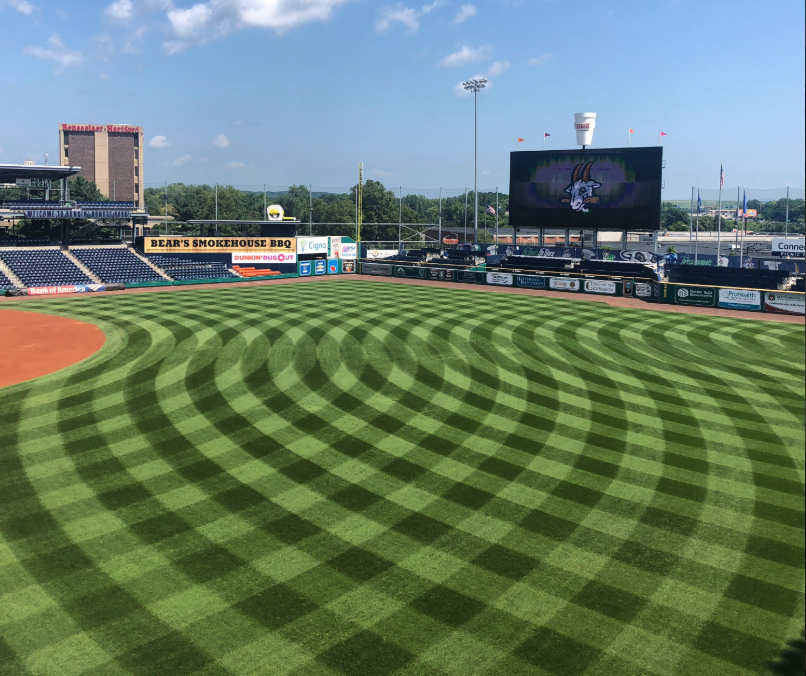
To the untrained eye, a professional sports field is just a beautifully manicured lawn. To a sports turf manager, it is a highly complex, biological canvas that requires an deep understanding of agronomy, physics, and engineering. The immaculate checkerboard patterns and razor-sharp lines you see on TV don’t happen by accident. They are the result of meticulous game-day prep routines.
The Art of the Pattern
Those stunning dark and light green patterns on soccer pitches and baseball outfields aren’t created by different types of grass or dyes. They are created entirely by bending the blades of grass.
[Mower Moving North] ---> Grass bends forward ---> Reflects light away ---> Looks LIGHT GREEN
[Mower Moving South] ---> Grass bends backward --> Reflects light toward you -> Looks DARK GREEN
Mowers are equipped with heavy rollers behind the cutting blades. When the roller passes over the grass, it bends it in the direction the mower is traveling. Turf managers carefully map out intricate geometric designs to enhance the visual spectacle for fans and television cameras.
The Perfection of the Paint
Field marking paint is a science of its own. Unlike standard household paint, athletic field paint must be formulated to stick to a living, growing organism without killing it.
- Brightness: Premum paints contain high concentrations of optical brighteners to ensure lines pop under heavy stadium lighting.
- Temporary vs. Permanent: Multi-use stadiums that host both football and soccer in the same weekend use specialized synthetic paints that can be easily washed away with a pressure washer and a specific chemical solution without damaging the underlying synthetic turf or grass.
Water and Moisture Management
Managing the moisture levels of a field is crucial for player safety and ball physics.
- Slickness Control: Professional soccer fields are often watered heavily just 15 minutes before kickoff. This skims the surface, allowing the ball to skip and glide faster across the pitch, promoting a rapid, dynamic style of play.
- Compaction and Aeration: To prevent the soil from packing down like concrete under the feet of 300-pound linemen, ground crews routinely perform core aeration. They punch millions of tiny holes into the dirt to allow oxygen, water, and nutrients to penetrate deep into the root zone, keeping the ground springy and safe.
The next time you watch a game and marvel at a perfect bounce or a flawless stop on the sidelines, remember the unsung heroes of the grounds crew working behind the scenes to keep the field in peak condition.
Leave a Reply